

Why CO2 Refrigeration Systems Are Growing in Supermarkets and Cold Storage
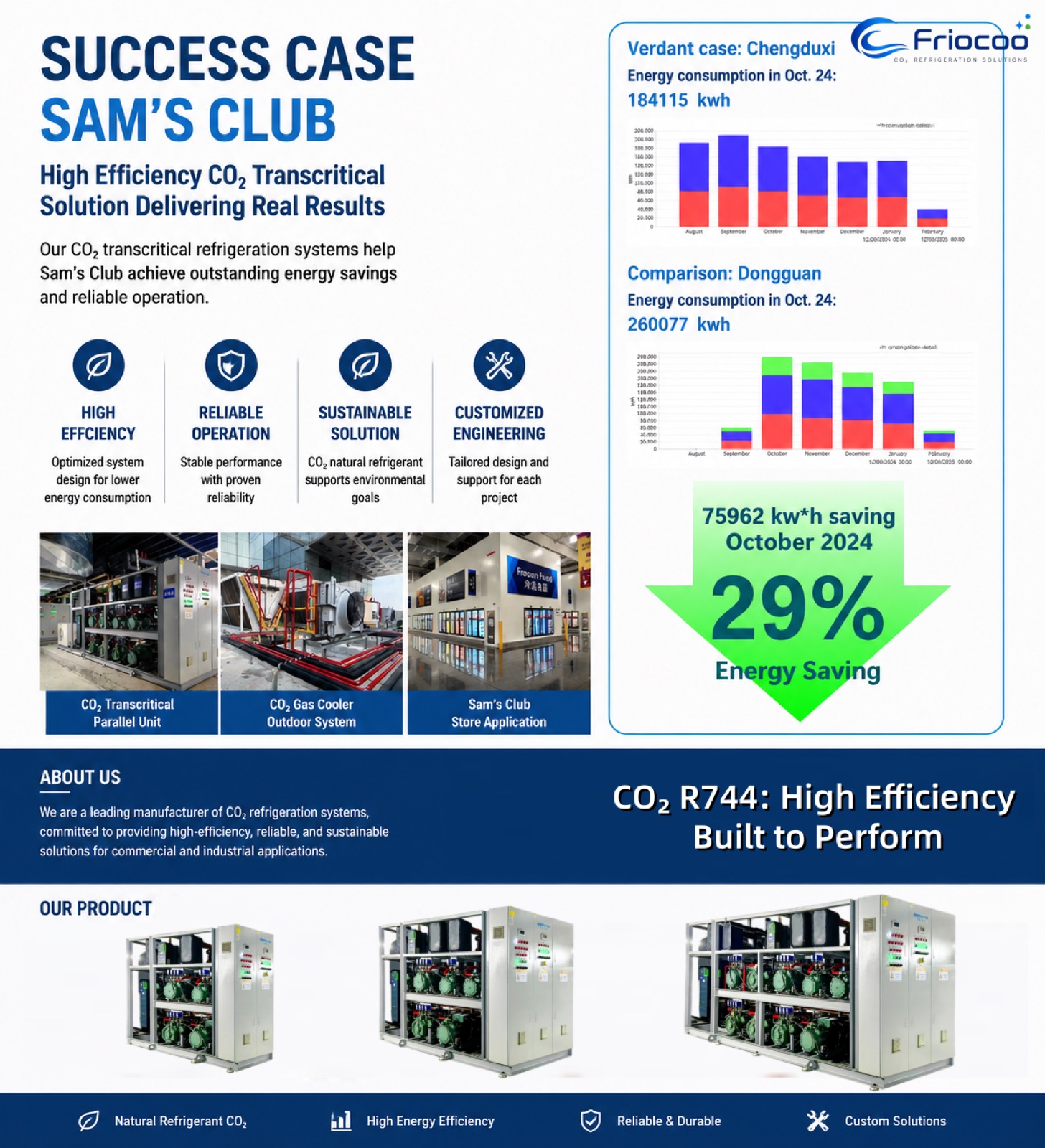
CO2 refrigeration systems are gaining attention in supermarkets, cold storage, and food logistics because buyers need lower-GWP refrigerants, long-term compliance, and efficient medium- and low-temperature cooling.


CO2, also known as R744, has an ozone depletion potential of 0 and a global warming potential of 1. That makes it very different from traditional refrigerants such as R22, R404A, and R507, which face environmental and cost pressure in many markets.
Why buyers are looking at CO2 / R744
Commercial refrigeration systems often run day and night for years. Refrigerant choice affects compliance risk, operating cost, maintenance planning, and long-term system value.
CO2 / R744 attracts buyers because:
- It is a natural refrigerant.
- It has ODP 0 and GWP 1.
- It is non-flammable and non-explosive.
- It can support medium-temperature and low-temperature refrigeration.
- It fits the direction of lower-GWP refrigeration planning.
These benefits do not remove the need for proper engineering. CO2 systems operate under higher pressure than many traditional refrigerant systems, so design, components, installation, and service knowledge matter.
Supermarkets need both chilled and frozen cooling
Supermarkets often need one system strategy for multiple temperature zones. Chilled display cabinets, cold rooms, frozen cases, and storage areas may all operate together.
Customer materials describe CO2 as a system designed to cover medium-temperature and low-temperature needs. The materials explain a transcritical system for medium-temperature chilled storage and a subcritical system for low-temperature frozen storage.
This positioning connects CO2 refrigeration to a real buyer problem: supermarkets need stable cooling across different zones, not one isolated unit.
Cold storage and food logistics need long-term reliability
Cold storage operators care about stable temperature, energy use, and future compliance. A refrigeration system is not a short-term purchase. It is infrastructure.
For cold storage and food logistics, CO2 systems may be considered when the project needs:
- Lower-GWP refrigerant planning.
- Medium and low temperature capability.
- Long-term regulatory direction.
- Efficient heat transfer under suitable conditions.
- Engineering support for system design.
Base the final decision on load, local climate, safety standards, service capability, and lifecycle cost.
What about safety?
CO2 systems operate at high pressure, so buyers often ask whether they are safe. The honest answer is simple: high pressure requires correct design and qualified engineering.
Customer-approved source materials mention CO2 piping design pressure above 80 bar, high-pressure side ratings up to 120 bar, reinforced tube wall thickness of 0.6 mm for MT lines and 0.75 mm for LT lines, tube diameters of 9.52 mm and 12.7 mm depending on function, and operational experience since prototype testing in 2016.
The article can state that CO2 refrigeration safety depends on proper system design, pressure-rated components, installation quality, testing, and trained service support.
Energy efficiency potential
Customer-approved source materials include a Chengdu Sam's Club example comparing October electricity use between a CO2 system and a traditional HFC system. The Chengdu store used two CO2 transcritical booster racks serving 56 display cabinets and 41 evaporators. In the cited October comparison, the Chengdu store consumed 184,115 kWh, while a comparable store using a traditional HFC system consumed 260,077 kWh. That is a difference of 75,962 kWh in one month.
The same source materials describe inverter-driven compressors, electronic expansion valves, and high-efficiency gas coolers as part of the system's efficiency approach.
| Chengdu Sam's Club case item | Customer-provided data |
|---|---|
| System type | Two CO2 transcritical booster racks |
| Connected equipment | 56 display cabinets and 41 evaporators |
| CO2 October electricity use | 184,115 kWh |
| Comparable HFC store October electricity use | 260,077 kWh |
| Reported monthly difference | 75,962 kWh lower electricity use |
This is a single project example, not a universal guarantee. It shows why buyers should evaluate CO2 refrigeration through real load, controls, climate, and operating data.
Where COM-ENERGY products fit
COM-ENERGY customer materials position CO2 as a CO2 / R744 refrigeration solution for supermarkets, convenience stores, cold storage, and industrial cold-chain applications. The materials describe multiple series for different project sizes, from small stores to large storage projects.
This makes CO2 / R744 a strong technical topic for COM-ENERGY, even if SEMrush data does not show it as the highest-volume keyword group.
CO2 series selection range
| Series | Medium-temperature capacity | Low-temperature capacity | Typical application |
|---|---|---|---|
| VERDANT SMART | 0.7-54.4 kW | 0-22.6 kW | Community shops and convenience stores |
| VERDANT SMALL | 17.8-138 kW | 0-37.1 kW | Small and medium supermarket projects |
| VERDANT MIDDLE | 82-321.3 kW | 0-67.8 kW | Larger supermarkets and cold storage |
| VERDANT LARGE | 118.7-431.5 kW | 0-152.7 kW | Large commercial refrigeration systems |
| VERDANT INDUSTRY | 118.7-898.9 kW | 0-229.1 kW | Industrial cold-chain projects |
Request a project recommendation
For a CO2 / R744 refrigeration project, prepare store or warehouse layout, medium- and low-temperature loads, local ambient temperature, display cabinet quantity, cold room quantity, safety standards, and service requirements. COM-ENERGY can then help evaluate whether a CO2 solution is suitable.
FAQ
Is CO2 the same as R744?
Yes. R744 is the refrigerant designation for carbon dioxide used in refrigeration systems.
Is CO2 refrigeration only for supermarkets?
No. It can also be used in cold storage, food logistics, and other commercial or industrial refrigeration applications when the project conditions fit.
Is CO2 always cheaper to operate?
Not always. Operating cost depends on system design, climate, load, controls, installation quality, and maintenance. The Chengdu Sam's Club example shows strong savings in one published case, but each project should still be evaluated on its own operating conditions.
Conclusion
CO2 / R744 refrigeration is growing because it answers a real market need: lower-GWP refrigerant, long-term compliance direction, and efficient commercial refrigeration design for medium and low temperature applications.
For supermarkets and cold storage projects, evaluate CO2 as a full system decision, not a simple refrigerant swap.
Posted in Refrigeration Technology on Jun 01, 2026